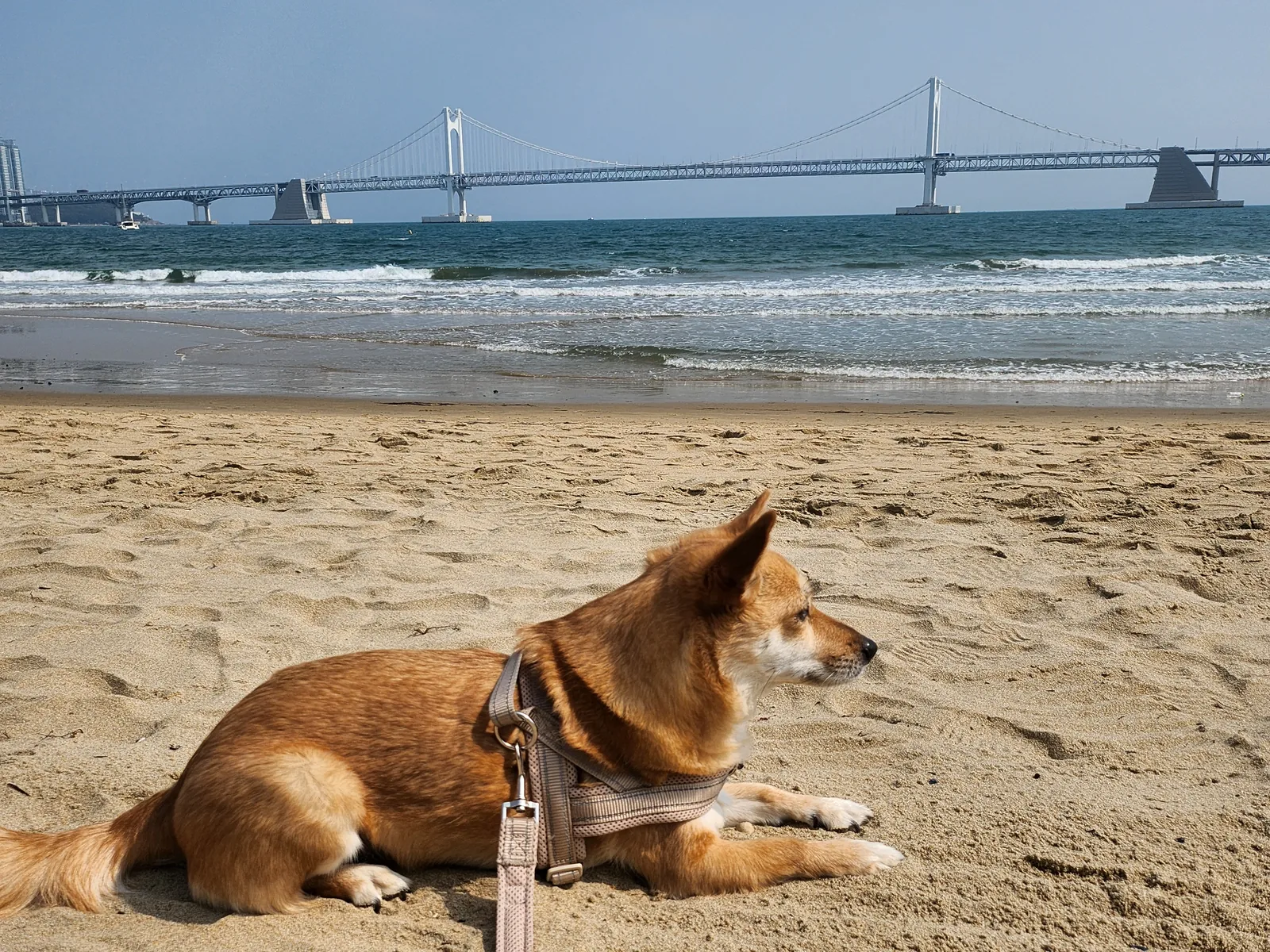
For the bridge itself, the sharpest frames I have are from clear afternoons. For the lights, plan to be on the sand by half an hour after sunset; in my one night frame they were already on by then. That’s what five sets of my own dated photos from Gwangalli Beach (광안리해수욕장) show, and this page lays them side by side so you can pick a time for your one visit.
How this page was made: The photos are mine, taken by phone on the dates shown, and the clock times come from each file’s camera data. The text was drafted with an AI assistant working from those photos and from the official pages linked at the end. Where the photos don’t show something, it is either sourced or listed under what I did not check.
Who this is for: you have two to four nights in Busan, one slot for Gwangalli, and you want to know whether to spend it at midday or after dark.
Five visits, side by side
The Gwangan Bridge (광안대교, Gwangandaegyo) runs across the bay in front of the beach. The city lists it as a 7,420 m, two-level, eight-lane motorway, and this page is about seeing it from the shore. Every row below is one of my visits. I’ve described only what is in the frame.
| When and where | What the frame shows |
|---|---|
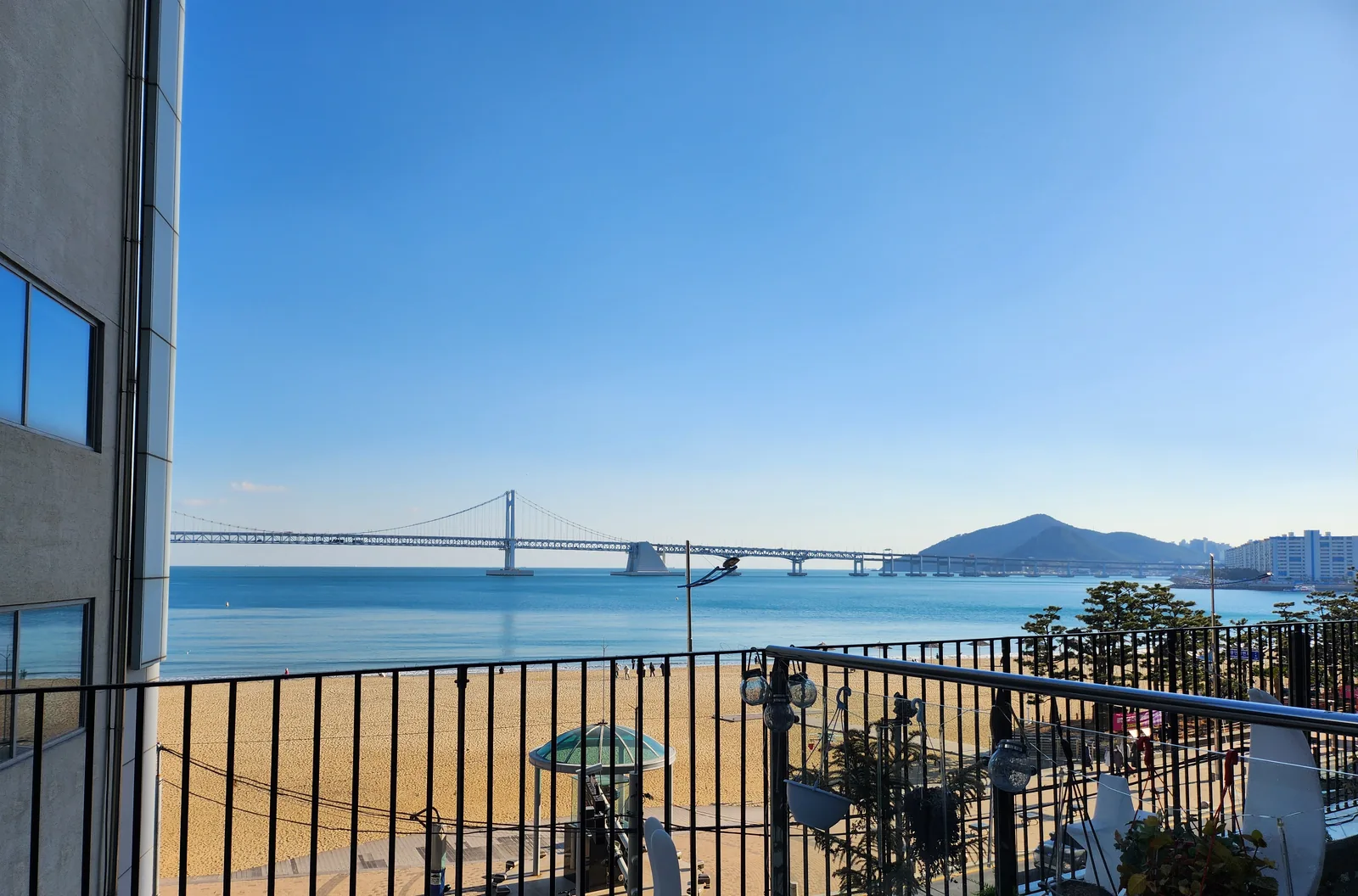
| 2025-01-16 (Thu), 14:56 Raised terrace across the beach road | Cloudless, with flat pale-blue water. Whole span sharp; the hill behind its far end clear. |
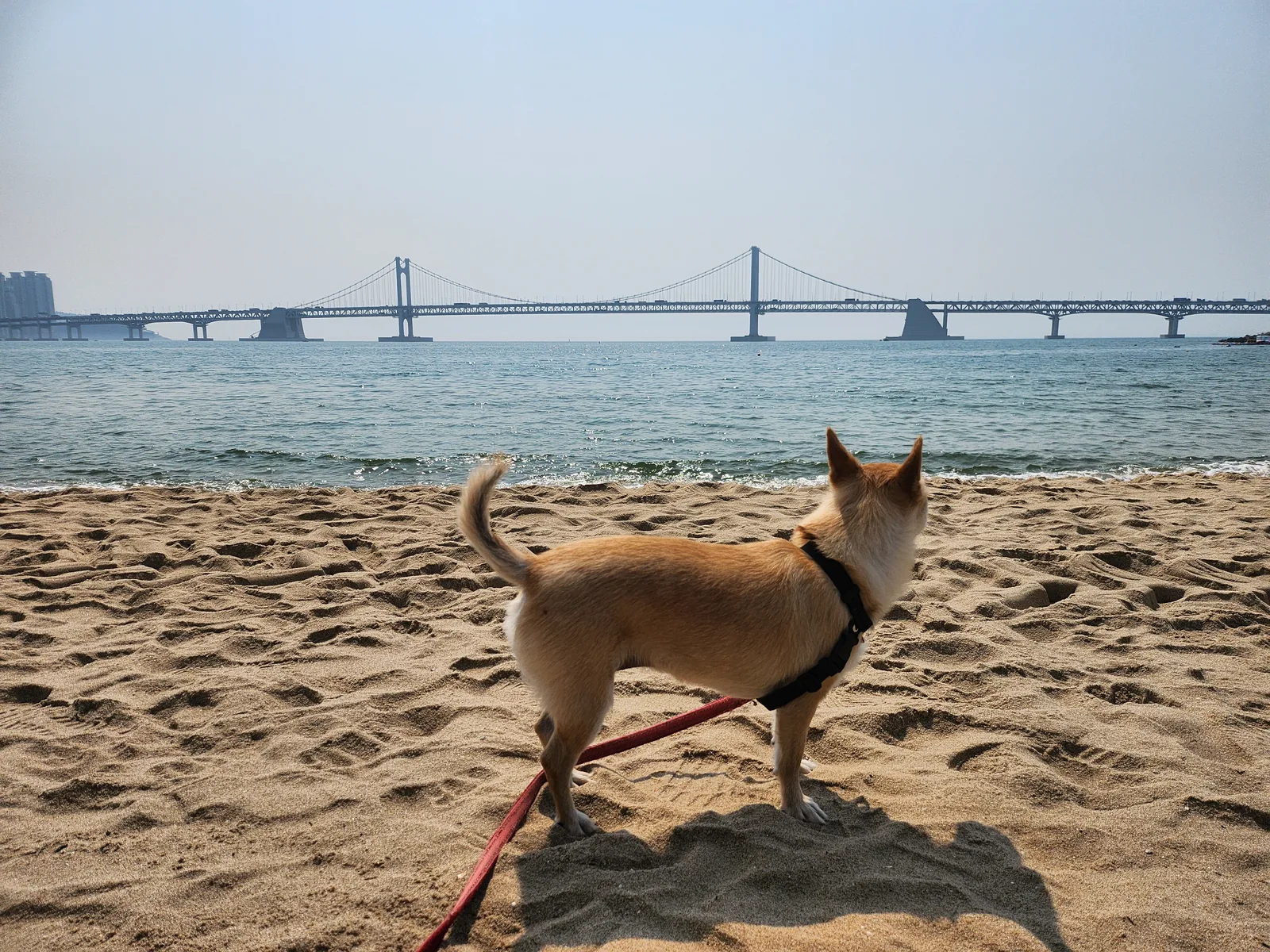
| 2025-05-27 (Tue), 09:36 to 09:41 Dry sand, near the water | White haze and small glittering ripples. A grey outline; cables readable, colour gone. |
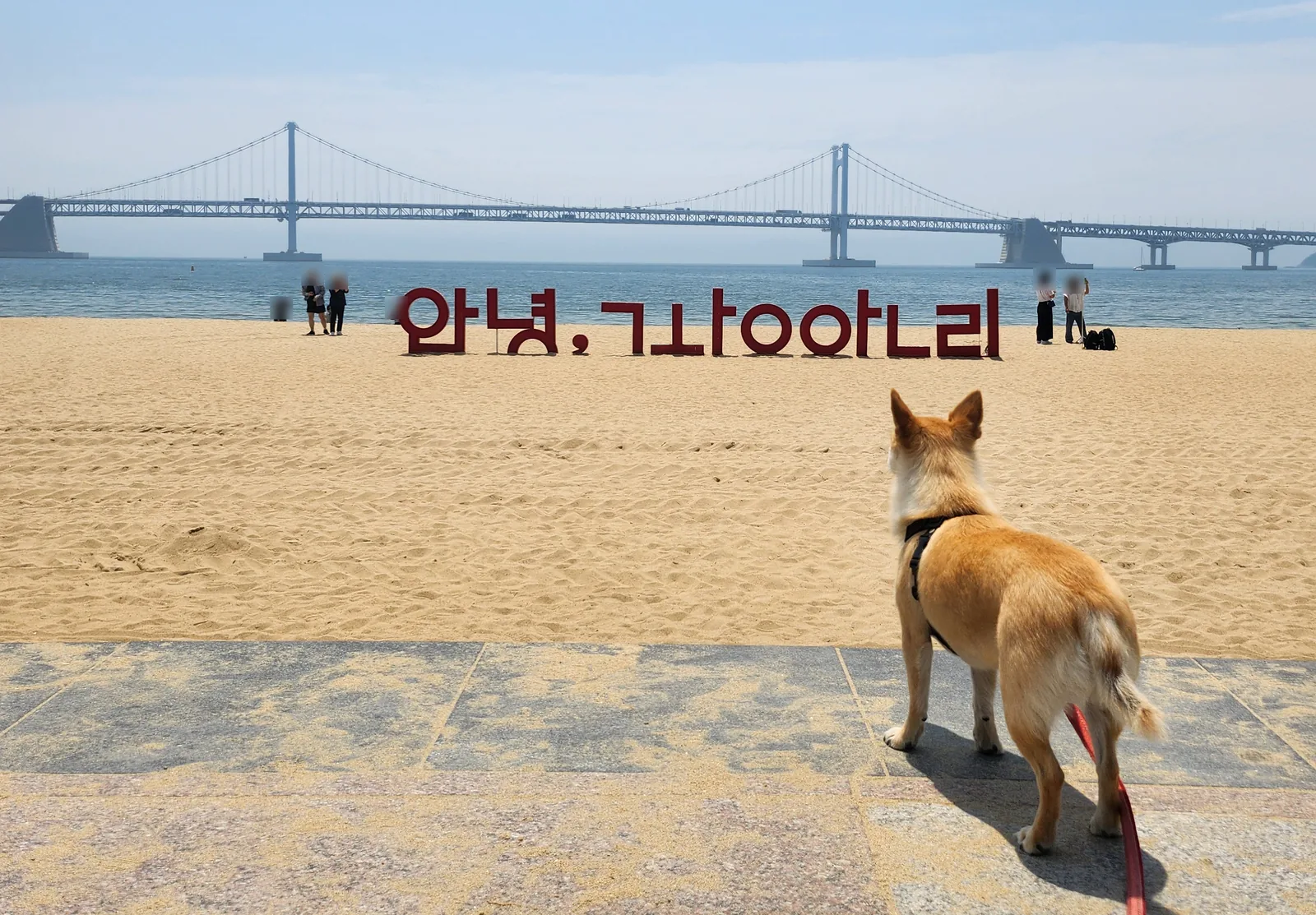
| 2025-06-10 (Tue), 11:32 Promenade edge, behind the 안녕, 광안리 sign | Thin high cloud, pale blue. Clear, but paler than the January and March frames. |
| 2025-07-10 (Thu), 20:07 Wet sand at the waterline | Deep-blue dusk under cloud, with surf. Cables lit blue and pink, a blue band along the deck; the anchor block dark. |
| 2026-03-19 (Thu), 13:29 On the sand | Blue-grey sky and lines of white surf. White towers crisp; vehicles visible on the deck. |
By day, the sky decides
Clock time mattered less than the air. My two clearest daytime frames are the January afternoon above and the March one at the top of this page, taken at 13:29 with surf running and a bank of cloud overhead. In both, the towers are white against blue, and in the March frame you can pick out vehicles on the deck.
Compare that with the late-spring morning. At 09:36, more than four hours after sunrise, the bridge was a grey outline behind white haze. The shape was all there. The colour wasn’t.
Two weeks later, at 11:32, it sat in between: clear enough to read the cables, paler than winter. That frame also shows the 안녕, 광안리 (“Hello, Gwangalli”) sign from behind. From the promenade the letters run backwards, because the sign faces the water.
Five visits can’t tell you how often each kind of day comes round. They do show the range, and they’re why I’d look at the sky from your window before committing a daytime slot. My seasonal calendar has month-by-month notes on weather and air.
After sunset, the lights
On 10 July 2025 I was at the waterline at 20:07. The Korea Astronomy and Space Science Institute (KASI) lists sunset for Busan that day at 19:41 and the end of civil twilight at 20:10. So about 27 minutes after sunset the lights were already on: blue and pink up the cables, a blue band along the deck, and blue reflections on the water in front of the surf.
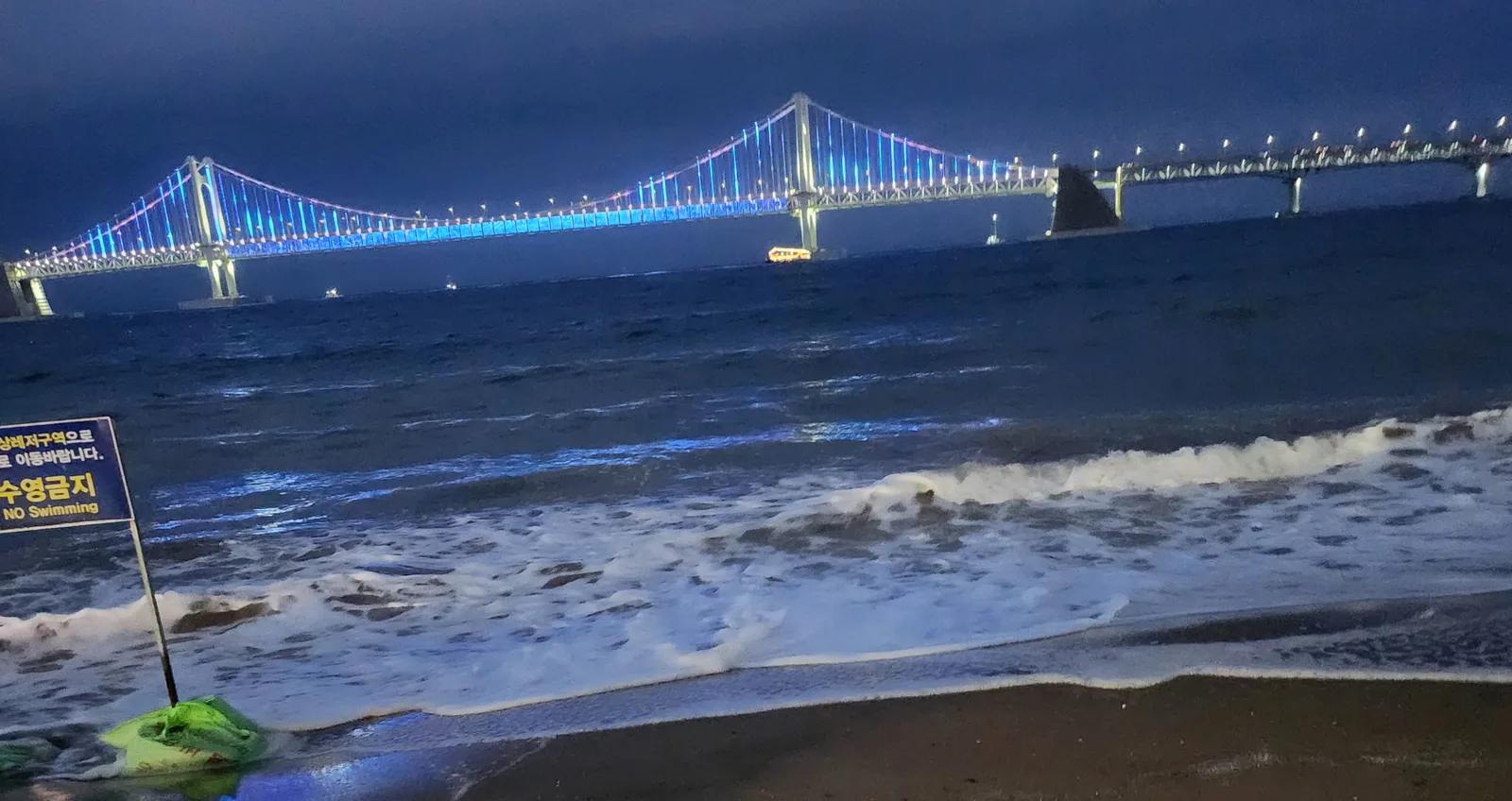
One thing in that frame is out of date. The concrete anchor block at the right is dark. Busan City announced on 13 November 2025 that a lighting upgrade had finished on 26 October: fixtures up from 7,011 to 13,465, spacing halved from 1 m to 0.5 m, moving lights added, and a second phase that put 4,245 fixtures on the anchorages. My photo was taken before that phase was finished. I haven’t photographed the bridge at night since, so expect more light than you see here.
Timing for this month: KASI’s Busan table gives sunset at 17:52 on 13 October 2026 and 17:31 on 31 October. Saturdays add the Gwangalli M Drone Light Show over the beach. The city’s notice lists it every Saturday, at 19:00 and 21:00 from October to February and at 20:00 and 22:00 from March to September, about 12 minutes each, free, and liable to be cancelled or delayed for rain or strong wind.
Where to stand, and how to get there
You don’t need a particular spot. The district office describes the beach as 1.4 km of sand, between 30 and 111 m wide, and the bridge is in every frame I took from the sand or the promenade. Low on the sand, the deck sits just above the horizon and the water fills the foreground. From the raised terrace, the sand and the bay both fit under it.
Getting there is one line. The city’s page for the beach lists Gwangan Station (광안역) on Metro Line 2, exit 3 or 5, and free admission, and gives (051) 610-4744 for enquiries. If the name is new to you, the glossary has the short version of Gwangalli.
Questions you might have
Is a hazy day a wasted trip?
Not for the shape. In my hazy frame the towers and cables are all readable; what you lose is colour and the far shore.
Can I swim in front of the bridge?
Not everywhere. Where I stood in July 2025, a sign at the waterline read 수영금지, No Swimming, and the cut-off line above it mentions a water-leisure zone. I haven’t checked the current zones or season dates.
Should I bring my dog onto the sand?
My dog is in these photos on a leash, which records my walks, not the rule. I haven’t confirmed the district’s current rule for dogs, in or out of swimming season. Call the enquiry number above before you plan around it.
Where these facts come from
- Busan Metropolitan City, Gwangalli Beach (location, admission, metro exits, enquiry number): busan.go.kr/eng/beaches/1326145, checked 13 October 2026.
- Busan Metropolitan City, Busan’s Seven Bridges (length, levels, lanes and function of the Gwangan Bridge): busan.go.kr/eng/the-seven-bridges-of-busan, checked 13 October 2026.
- Busan Metropolitan City, press release of 13 November 2025 on the bridge lighting upgrade, with attached PDF (Korean): busan.go.kr/nbtnewsBU/1705990, checked 13 October 2026.
- Busan Metropolitan City, notice of 2 September 2026 on the Gwangalli M Drone Light Show schedule: busan.go.kr/eng/bsnews01/1752366, checked 13 October 2026.
- Suyeong-gu Office, Gwangalli Beach introduction (length and width of the sand; Korean): suyeong.go.kr, 광안리 해수욕장, checked 13 October 2026.
- Korea Astronomy and Space Science Institute, monthly sunrise and sunset tables, Busan (Korean): astro.kasi.re.kr/life/pageView/6, checked 13 October 2026.
What I did not check: the current switch-on and switch-off times for the bridge lights (the operator’s old lighting page no longer loads, and its address now leads to the toll-payment site); how the bridge looks at night since the October 2025 upgrade; the current rules on dogs, swimming zones and season dates; whether the drone show is running on any particular Saturday; the air-quality record for the hazy morning; and anything before 09:36, including sunrise. I have not named the building with the terrace or checked whether visitors can use it. Five visits are a sample, not a forecast.