
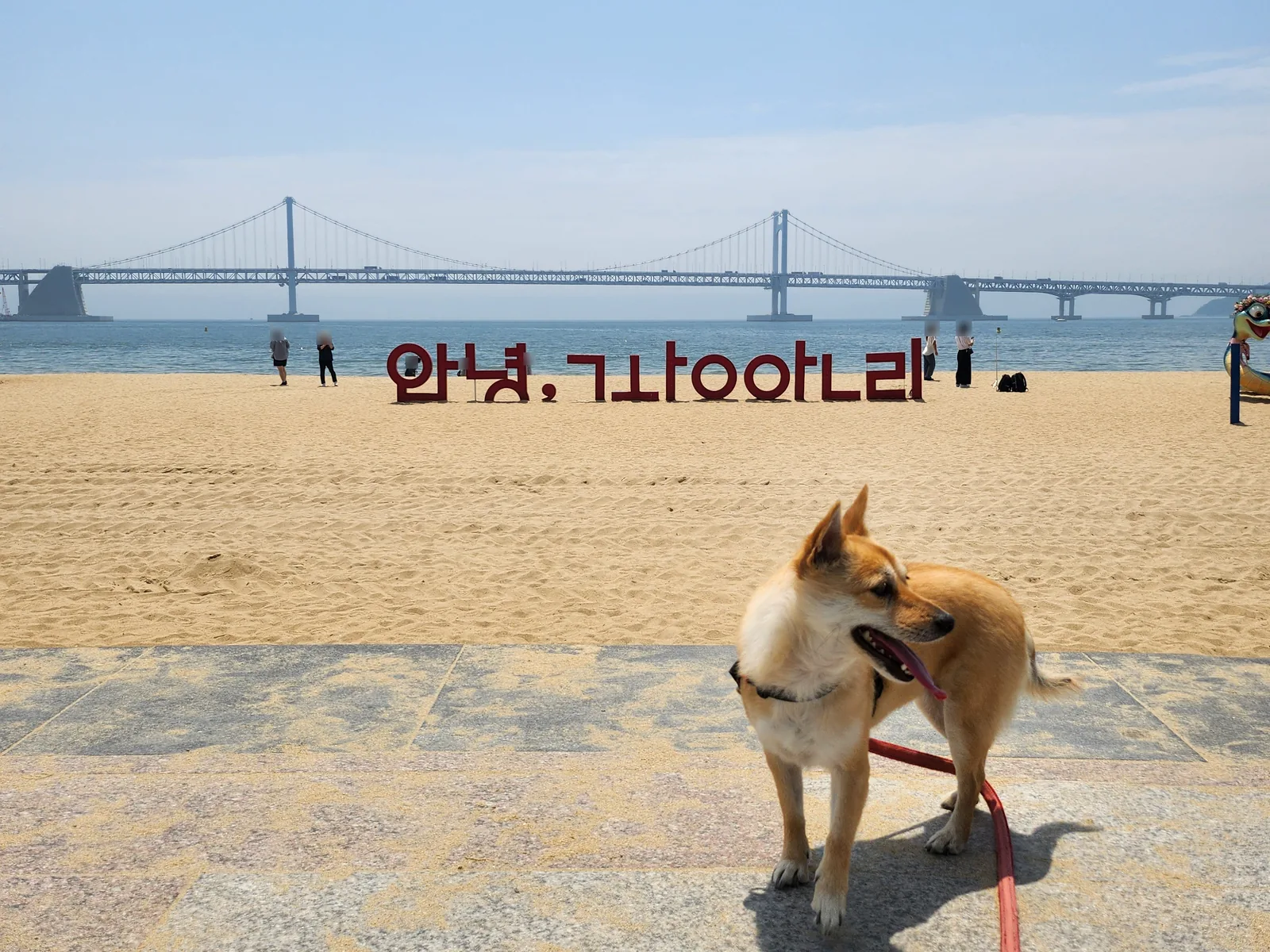
Yes, going by the written rules. Neither the national beach law nor the beach ordinance of Suyeong-gu, the district that runs Gwangalli Beach (광안리해수욕장), bans dogs from the sand in the versions in force on 14 October 2026. The rules that do apply come from animal-protection law, and they’re short: keep the dog on a lead of 2 m or less, put a name tag on it, and pick up after it. On the metro it has to travel in a closed carrier.
How this page was made: The photos are mine, of my own dog, taken by phone; dates and times come from each file’s camera data. The text was drafted with an AI assistant, which checked the Korean legal texts and official pages linked at the end on 14 October 2026. It’s a plain reading of published rules, not legal advice, and nobody at the district office has reviewed it.
Who this is for: you’re in Busan with your dog, on a trip or because you live here, and you want to walk it on the sand without getting the rules wrong.
What the beach rules leave out
Article 22 of the national Act on the Use and Management of Beaches (해수욕장법) is the list of things nobody is allowed to do on a designated beach. It covers trading without a permit, littering, camping or cooking outside set areas, swimming outside the marked zone or hours during the season, driving onto the sand, toy fireworks outside permitted times and places, smoking in no-smoking zones, running remote-controlled powered devices on the sand during opening hours without permission, taking sand or stones, and damaging facilities. Animals aren’t mentioned anywhere in the act. Its last item lets each district add rules of its own.
Suyeong-gu’s Beach Management Ordinance (부산광역시 수영구 해수욕장 관리 조례) uses its rules article, Article 15, to point back to that national list and to the district’s no-smoking zones. Neither the version in force since 20 May 2026 nor the one in force on 10 July 2025, the evening of the waterline photo further down, mentions animals at all.
One layer could still change the answer. Busan’s Ordinance on Animal Protection and Welfare lets the mayor bar dogs from specific places by public notice (Article 8). This page didn’t turn up such a notice for Gwangalli, but it didn’t search every notice the city has issued, so that’s the one point worth a phone call before you plan a stay around beach walks. The numbers are in the questions below.
What you have to do on the sand
Everything in the table below comes from the national Animal Protection Act and its rules, and Busan’s and Suyeong-gu’s animal ordinances repeat it. The duties attach to what the law calls registrable dogs, which the enforcement decree defines as pet dogs aged two months or older. On a plain reading, a dog on holiday with you counts.
| Rule | What it says |
|---|---|
| Lead | A lead or harness line of 2 m or less, or a carrier that locks. A puppy under three months can be carried in your arms instead. |
| Name tag | The dog’s name and your contact number, plus its registration number if it’s registered in Korea. |
| Poo | Pick it up straight away. Busan’s and Suyeong-gu’s ordinances add that you should carry bags or gloves for it. |
| Five listed breeds | Tosa, pit bull terrier, American Staffordshire terrier, Staffordshire bull terrier, rottweiler and their crosses: from three months old, a muzzle as well as the lead, or an escape-proof carrier. |
| Fine | Up to ₩500,000 for going without the lead, the tag or the clean-up. |
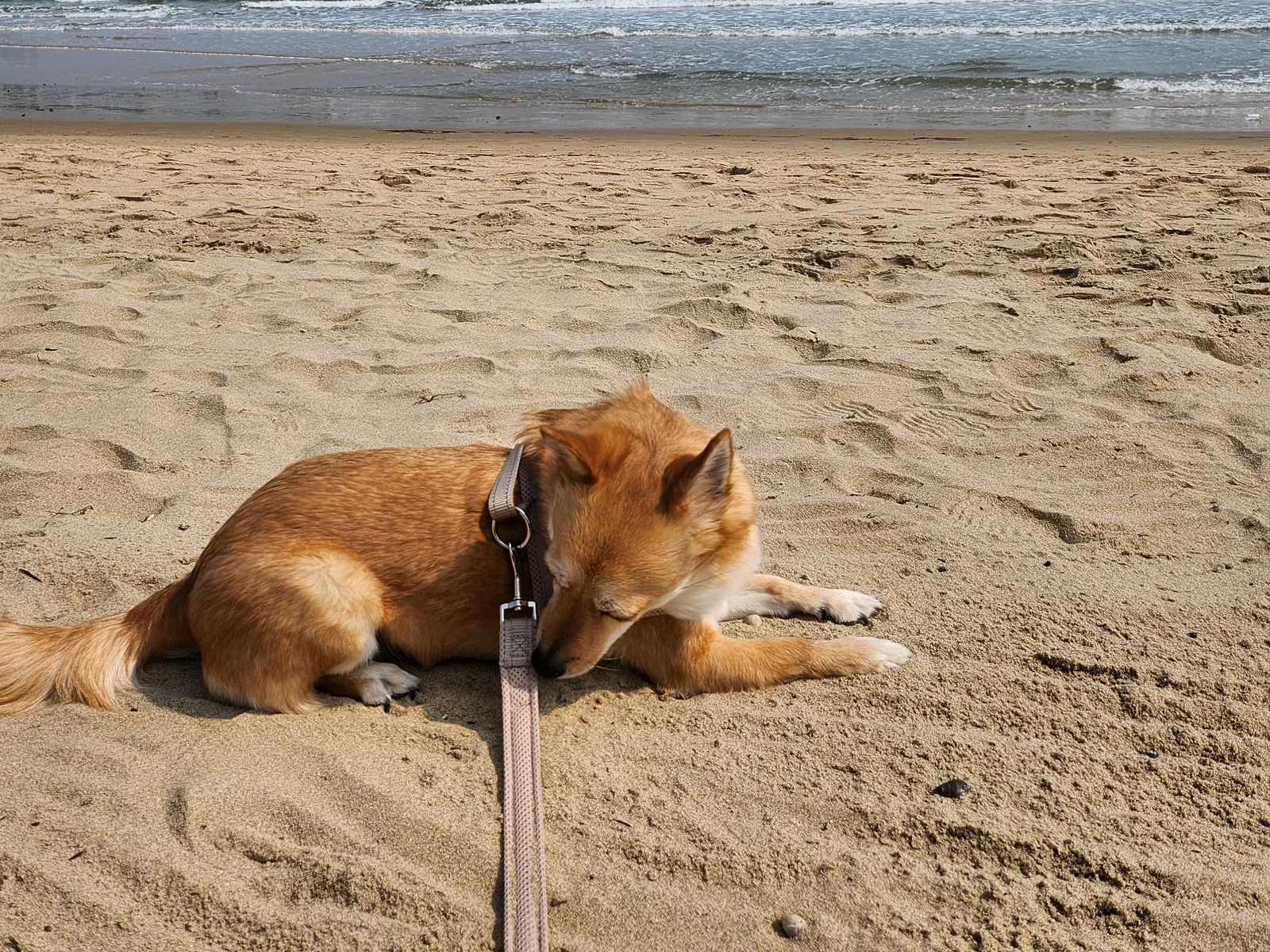
In all three photos on this page, the lead is clipped to a harness: red in June and July 2025, beige in March 2026. That’s all the photos prove. They don’t show how long the lead is, whether there’s a tag, or what’s in my pockets.
The part no rule covers: the water
The beach law’s swimming rule is written for people. During the bathing season, nobody is allowed into the sea outside the marked zone or hours. It says nothing about dogs in the surf, and I haven’t asked the district how its lifeguards handle one. In season, the simple choice is to keep your dog on the sand.
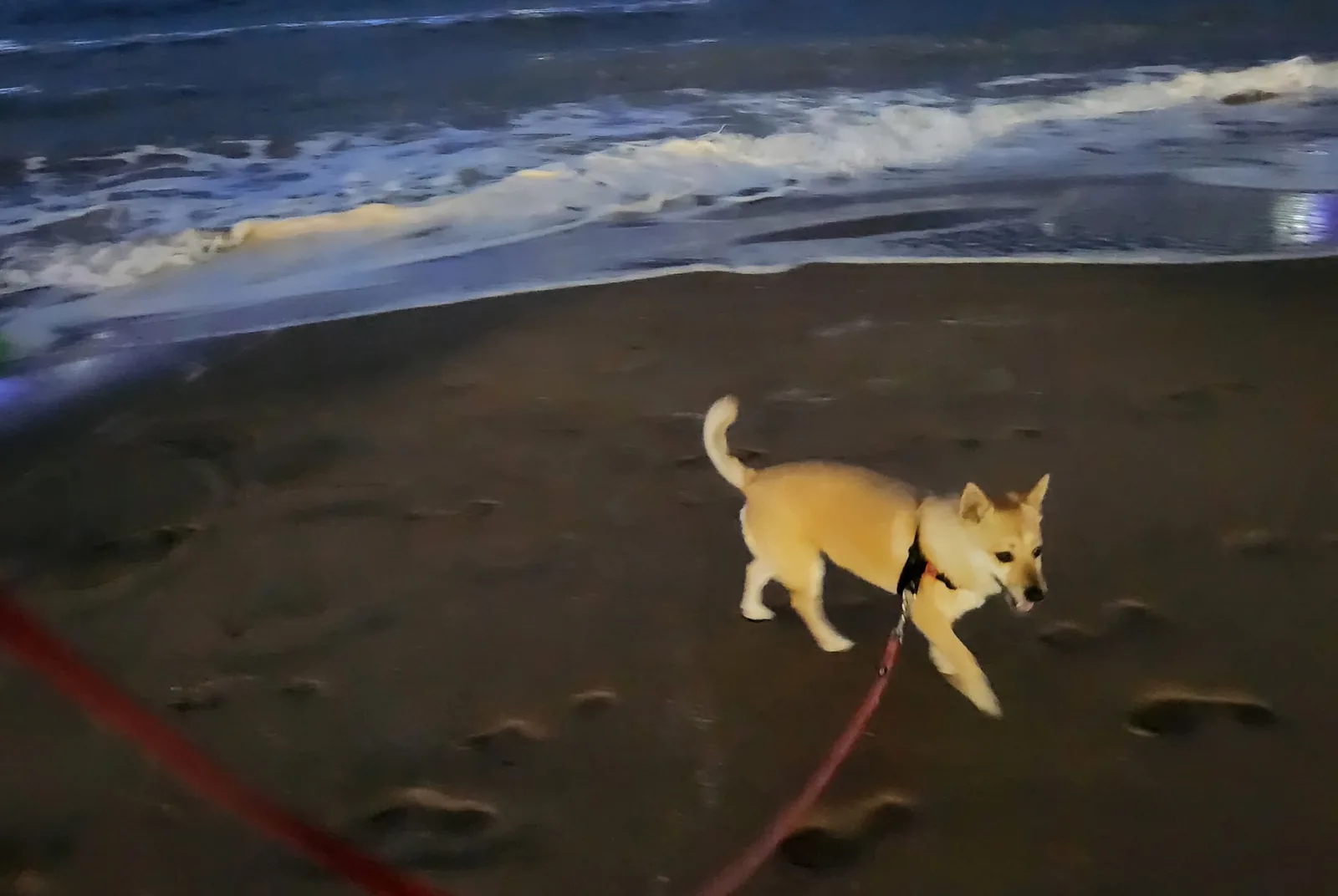
After dark, nothing in these texts changes. The animal rules have no hours attached, so the lead and the bags apply at 8 p.m. as much as at noon.
Getting there with a dog
The city’s page for the beach gives Gwangan Station (광안역) on Metro Line 2, exit 3 or 5. With a dog, that route needs a carrier. Busan Transportation Corporation’s passenger terms (Article 14) keep animals out of stations and trains, with two exceptions: a pet in its own carrier, closed so the animal can’t be seen and without an unpleasant smell, and an assistance dog travelling with a disabled passenger. A dog on a lead, however short, isn’t either.
If you’re also choosing a time of day, I compared five dated visits to the same sand in when to see the Gwangan Bridge from Gwangalli Beach. For the name itself, the glossary has a short entry on Gwangalli.
Questions you might have
Is summer different?
Not in these texts. Neither the beach law nor the district ordinance sets a separate dog rule for the bathing season. The district announces each year’s season dates and hours on its website; I haven’t checked this year’s.
Can my dog run off the lead on the sand?
No. The 2 m rule covers any time you take the dog out. Busan’s ordinance describes fenced dog parks as the places built for running without a lead.
Who can confirm all this?
The city’s beach page gives (051) 610-4744 for enquiries. On law.go.kr, Suyeong-gu lists its tourism and sports division, (051) 610-6534, as the office for the beach ordinance.
Where these facts come from
- Act on the Use and Management of Beaches, Article 22, in force from 2026-07-01 (Korean): law.go.kr, 해수욕장의 이용 및 관리에 관한 법률, checked 14 October 2026.
- Suyeong-gu Beach Management Ordinance, Articles 7 and 15, in force from 2026-05-20 (Korean): law.go.kr, 수영구 해수욕장 관리 조례; the version in force from 2025-07-01: law.go.kr, 2025 version; both checked 14 October 2026.
- Animal Protection Act, Articles 16, 21 and 101, in force from 2026-07-07 (Korean): law.go.kr, 동물보호법, checked 14 October 2026.
- Enforcement Decree of the Animal Protection Act, Article 4 (Korean): law.go.kr, 동물보호법 시행령, checked 14 October 2026.
- Enforcement Rule of the Animal Protection Act, Articles 2, 11 and 12 (Korean): law.go.kr, 동물보호법 시행규칙, checked 14 October 2026.
- Busan Metropolitan City Ordinance on Animal Protection and Welfare, Articles 2, 7 and 8, in force from 2026-05-20 (Korean): law.go.kr, 부산광역시 동물 보호 및 복지에 관한 조례, checked 14 October 2026.
- Suyeong-gu Ordinance on Animal Protection and Management, Article 6, in force from 2024-09-10 (Korean): law.go.kr, 수영구 동물보호 및 관리에 관한 조례, checked 14 October 2026.
- Busan Transportation Corporation, passenger transport terms, Article 14 (Korean): humetro.busan.kr, 여객운송약관, checked 14 October 2026.
- Busan Metropolitan City, Gwangalli Beach (metro exits, enquiry number): busan.go.kr/eng/beaches/1326145, checked 14 October 2026.
What I did not check: whether Busan City has issued a notice under Article 8 of its animal ordinance that covers Gwangalli or part of it; any signs posted on the beach during the 2026 season (I have no photos of them); how lifeguards treat a dog in the water; this year’s bathing-season dates and hours; rules for buses, taxis and intercity trains; whether officials apply the name-tag rule to visitors’ dogs; and any extra rules for crowded events on the beach. My photos show a lead and a harness, not the lead’s length, a tag or a bag. Nobody at the district office has reviewed this reading.